
Mouth
a short story

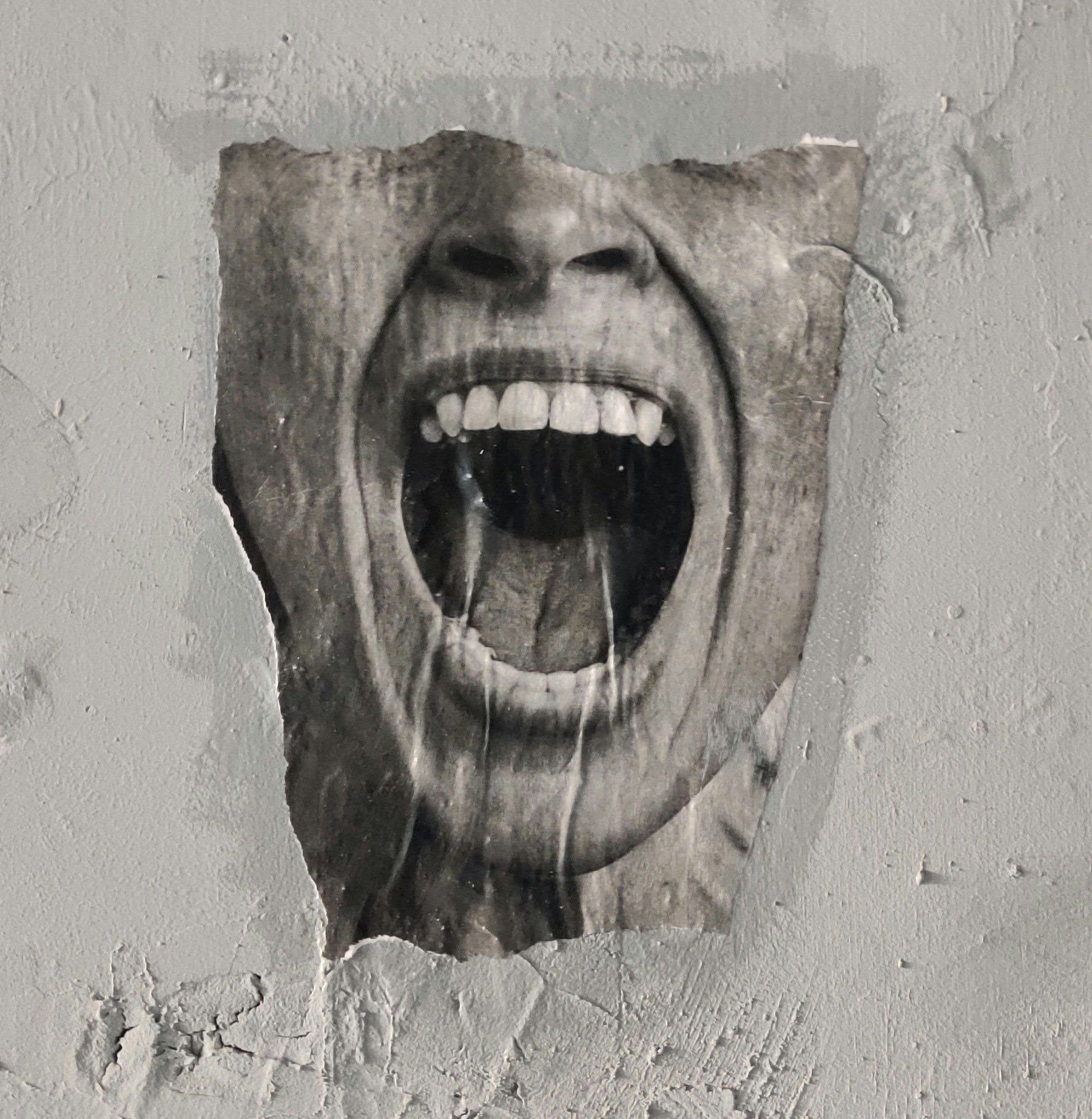
In the pale morning light, I slip noiselessly out of bed, wrap myself in my robe, and readjust my face veil. Glancing at the slow rise and fall of the sleeping figure in the bed, I take quick, cautious steps into the kitchen, being careful not to make a sound. I lift the pan gingerly from the cupboard, light the fire underneath it, and pray that the chunk of butter I hold poised in a spoon, ready to drop into it, doesn’t sizzle too loudly.
This is how I begin every morning, now that Hezekiah is gone.
I crack the eggs mechanically, every movement memorized, and let myself remember Hezekiah.
In those days, we woke at the same time, pressing our foreheads together as we held each other, savoring a final moment wrapped in the warm blankets, then rising from the bed to begin the day’s work.
Unbidden, the thought of pressing my forehead to Enoch’s thrusts itself into my mind.
I nearly retch.
Enoch’s eggs are cooked now, and I lift the pan from the fire, ready to take it to the table.
Something touches my waist, and I yelp and flinch.
The pan slips from my hand and clatters to the floor. Almost immediately, a fist lands on my temple. Then another, and another, until I am on the floor, my legs sliding in the hot eggs, my arms a useless shield against the blows.
These are my mornings now with Enoch.
“Stupid woman!” he yells, another punch landing. “Clean it up!”
I remain where I am on the floor another moment, bracing for another blow. But instead, I hear Enoch’s slow, heavy footsteps moving away.
With trembling fingers, I reach up toward the lower part of my face and feel for the fabric. Yes, it’s still there; I can feel the soft scratch of it against my fingertips.
I feel my body relax. What a relief: my modesty is still intact.
At least I still have my dignity.
For now.
Today is Sunday, and we stand obediently in the pews of the church until finally, the opening prayer over, the pastor commands us to be seated.
To my left is Abigail, once my childhood friend. We haven’t spoken since we each were married, but I still carry a fondness for her in my heart.
To my right is Enoch, the air around him heavy with threat. I allow myself one indulgent moment of self-pity to remember that it never felt like this sitting next to Hezekiah.
Sitting between us, there should be children, groomed and modestly dressed, bowing their angelic heads in prayer.
But I have never been blessed with a child.
The rumors were that it was Hezekiah who was unable to produce a child. People said he was too lenient with me, too kind, too gentle. People said a man like that could never father a child.
But after he died and I was given to Enoch, still no children came.
It is only one of the many reasons why Enoch hates me.
I focus again on the pastor’s voice, trying not to think about the fact that Hezekiah never hated me for not bearing him a child.
We are instructed to stand for a hymn. Enoch grumbles under his breath. He hates singing hymns almost as much as he hates me.
I hold the hymnal in front of him as the organ blares out its first deep, church-shaking notes. I want desperately to show him I’m a good wife. Maybe he will treat me better if I can convince him of this.
But also, I want to take this opportunity to practice my reading.
The song begins, and a chorus of male voices boom through the space, all the way up to the rafters. I move my eyes discreetly across the page, trying to follow along with the words.
I wonder what it would feel like to sing.
Beside me, Enoch trips across the second verse, reading too slowly to keep up. I remember Hezekiah, who read Scripture aloud to me every night, moving his finger under the words as he spoke them. He never ventured so far as to explicitly teach me to read; that would have been a sin. But he also never said anything on the occasions when he caught me trying it out for myself, sounding out words in Scripture when I thought no one was around to hear.
After the service, we walk to the Fellowship Hall, a slow-moving wave of people filing out of the pews. I already know what Enoch’s goal is.
When we reach the building, my husband gets in line for donuts. I stand beside him, watching the children play. The boys leap and shout, playing a ball game in the large open area. The girls, meanwhile, sit clustered against one wall, legs folded demurely underneath them, and play hand-clapping games, giggling behind their face veils. They haven’t yet learned to be silent.
We reach the front of the line, and Enoch grunts out a demand for two donuts. Taking the plate that is handed to him, he heads toward a table, and I follow.
We sit. Enoch places the plate in front of himself on the table. And he eats both donuts.
I watch the sugary fried dough disappear, feeling my stomach growl its annoyance.
Sometimes I’ve thought about asking Enoch to take one home so that I can have it. Of course I couldn’t eat it here in public, in front of men. But at home, I would be able to taste it.
I already know, though, that he would say no.
Enoch always eats both donuts.
That evening, I prepare dinner in silence while Enoch relaxes in his big upholstered chair. He doesn’t like going out, not even to church, so he spends every Sunday afternoon and evening sitting in that big chair, sometimes sleeping in it, but mostly looking at books he won’t allow me to see.
I know what is in them. I’ve snuck glances at them while bringing Enoch his tea and cake, and I’ve picked a few up off the shelf and leafed through them while he was sleeping.
They are not Scripture, like Hezekiah used to read. They are pictures. Sinful pictures of women’s bodies and faces, uncovered, with no clothes and no veils. One picture of a nude woman with her mouth opened wide shocked me so much, I never touched the books again.
I have learned to hide my disgust. But still, as I hear the turning of the pages, I feel my body tense up with fear.
Because I know what will happen tonight.
After Enoch looks at those pictures, he will want me to do terrible things. Depraved things. He will order me to take off my face veil, and he will do unspeakable things to my mouth. He knows what the Scripture says about carnal lust, about a woman’s mouth being unclean. He knows that not even a husband should ever look upon it.
He knows, and he does those things to me anyway.
Though I try not to, I picture the horrors that will happen tonight, and in my distraction, I nearly burn the potatoes.
I remove them from the fire and scoop them onto Enoch’s plate, a single tear falling from my eye.
That night, after forcing me to do the unspeakable, Enoch falls asleep. I immediately slip my face veil back on, wrap my robe around me, and pad barefoot through the dark house to the sink. I have to try to wash the sin out of my mouth.
I wish I could wash away the memories of it, too.
The soap tastes terrible, bitter and stinging, but I stay hunched over the sink for an eternity, scrubbing and rinsing, scrubbing and rinsing. Maybe I can burn my whole sinful mouth away, if I can find soap strong enough.
It was Eve and her mouth who led Adam astray. Eve, with her full red lips, her honeyed words, the apple proffered with one bite taken from it: the bite that her sinful mouth chewed and swallowed.
I know this. Hezekiah knew this.
Enoch knows it too, but he doesn’t care. I think he would have eaten not just the apple but the whole tree, if he had been there in that garden.
I’ve scrubbed enough. My tongue prickles and burns. I rinse my mouth a final time, then retrace my steps and kneel beside the bed to pray.
I pray for God to forgive me for what Enoch has just done to me and for whatever sins I have committed to warrant being punished in this way. I stop myself just as I am about to ask God why He has taken Hezekiah from me and given me to Enoch.
It is a sin to ask God why.
I ask forgiveness for questioning God, then pronounce a silent amen.
My prayers over, I lie down in bed, careful not to touch Enoch’s sleeping form.
When I close my eyes, I remember Hezekiah. I remember how gently, how carefully he had tried to put a child in me. How respectful he had been. How he had averted his eyes from my body. How he had never once, in his entire too-short life, seen my mouth.
The next day, after cooking breakfast and doing my morning chores, I get ready to go to the market. I gather my basket and my coat, reaching for the little purse of money that sits on the front table.
But as my hand moves toward the purse, Enoch leaps up from his chair and slaps it away. I stare at him in shock.
Mistake. Enoch doesn’t like it when I look him in the eye.
I know the blow is coming before it arrives, and a part of me has already accepted it before it even lands.
It knocks me to the floor anyway. I crumple, the basket splintering beneath my weight with a crack like tiny bones breaking.
“What in the devil do you need money for?” Enoch demands.
Keeping my gaze on the floor in front of me, I respond meekly, “I need to do the shopping. We need food.”
All I can hear is his breathing. Heavy, angry. He doesn’t move.
“We’ll both go,” he says finally.
He doesn’t help me to my feet.
The market today is busy. Crowded, bustling, with male and female bodies coming perilously close to touching as they push past one another to get to where they want to go.
This is a dangerous place.
Enoch moves beside me like a shadow, impossible to shake off or even get some distance from.
I try to ignore the gnawing feeling in my stomach as he walks too close beside me. Ahead of me is my first destination: the egg seller. In my left hand I clutch a sad, discolored cloth bag, a last-minute replacement for the broken basket I normally put the shopping in.
Standing in front of the egg seller’s table, I make a sign to him with my hand. Two dozen. They will last Enoch eight days.
The seller reaches out to take the bag from me. I feel my face burn with embarrassment. What kind of a woman goes shopping with a cloth bag instead of a basket?
I pull the purse from the pocket of my dress and watch as he counts out the eggs, placing them gently into the bag. He lifts it and hands it back to me, his deep voice announcing a price.
As I accept the bag from him, the tips of my fingers brush lightly against the back of his hand.
Horror, fear, and Enoch’s clenched fist hit me all at the same time.
“Harlot!” he roars, punching me again. I stagger, my ears ringing, trying not to collapse onto the table of eggs. The cloth bag is somewhere at my feet, the eggs for Enoch’s breakfasts broken and leaking through the fabric.
“Whore!”
Another blurred hand flies toward me, only this time, it’s not a fist.
Enoch grabs my face veil and rips it off of me, exposing my mouth to the entire market full of men and women.
I freeze. The entire marketplace is silent, the men gaping, the women averting their eyes in shock.
Something within me breaks.
I stand facing Enoch, my eyes burning. A breeze floats through the covered marketplace, and I feel the strange, unfamiliar sensation of wind across the lower part of my face.
Slowly, I open my mouth.
And I scream.
I scream out all my anger, all my pain, all my shame. I scream out my grief over Hezekiah, my disgust at being forced to sin night after night, my rage that God ever allowed any of this to happen to me.
I scream until my voice scratches and blisters in my throat, and then I scream some more.
Enoch stands bewildered, staring at me as if I were a rabid animal.
And then, still screaming, I notice a trickle of blood dripping from his nose.
I scream louder, more furiously, hardly needing to take a breath.
Blood is coming from his ears now too, wetting his shoulders as he stands unmoving, staring at me in horror.
Still I scream, my anguish flowing from my lungs, ripping through my vocal cords, shaking the flimsy tin roof of the marketplace.
Enoch is weeping blood. Blood pours from his eyes, his ears, his nose. Blood dribbles out of his slack mouth and onto the front of his shirt.
I’m still screaming. I can’t stop. There is so much pain inside me, desperate to come out.
The whole marketplace is splattered with red, covered in the blood of Enoch and the other men. The women cower in twos and threes, their clothes and veils spattered with red droplets, the men around them writhing red shapes on the ground.
I scream louder, louder, until inside myself I feel a sudden stillness I’ve never felt before.
I stop screaming.
I don’t know why, but my heart feels lighter now. I close my mouth, swallow, and breathe in the cool, still air through my nose.
The marketplace smells like a slaughterhouse, and the men on the ground aren’t writhing anymore.
With my thumb and forefinger, I lift my face veil gingerly off the ground and examine it. The coarse, scratchy fabric is completely soaked in blood. Is it Enoch’s? Someone else’s?
I look around. Women and small children stand huddled together, some of them murmuring now.
For the first time since I was a little girl, I don’t feel weighed down anymore. For the first time, I feel free.
I drop the veil onto Enoch’s wide, wildly staring eyes and wipe the blood from my fingers.
Then I step over his lifeless body and begin my walk back home.
I wasn't sure how horrific this was gonna be when I started reading. Woah. So layered and so darkly upsetting.
Amazingly done. Exceptional! Gets you right inside the horrific obscenity that is patriarchal monotheism.
I adore the ending. It scents like a kind of justice...